IUNEpherese™ Blood Purification at Cell4Care®: Explained Simply
Anyone researching medical blood purification will quickly come across a variety of terms. Some search for apheresis, others for blood plasma purification, and still others for a form of blood purification for complex health conditions.
At this point, we at Cell4Care® would like to clearly define what we stand for: When we refer to IUNEpherese™, we mean a medically supervised form of blood purification provided at our IUNE Medical Center by Cell4Care in Palma.
What does IUNE stand for in IUNEpherese™?
The name was chosen deliberately because we do not view blood purification as an isolated, technical procedure. For us, IUNEpherese™ represents a form of medical blood purification that is integrated into diagnostics, medical assessment, treatment planning, and accompanying therapeutic components. The name thus describes not only a procedure, but also the medical framework within which this blood purification takes place at our facility.
IUNEpherese™ is more than just blood purification
We made a conscious decision to offer this procedure as IUNEpherese™ blood purification because, for us, the focus is not solely on the device. In practice, therapeutic apheresis systems often operate on similar basic principles.
The key differences lie in the specific procedures involved: the filtration system, plasma management, temperature control, fluid load during treatment, and accompanying medical measures. This is precisely why we do not simply refer to apheresis in general terms, but to IUNEpherese™ as our form of medically supervised blood purification.
How the IUNEpherese blood purification treatment by Cell4Care works
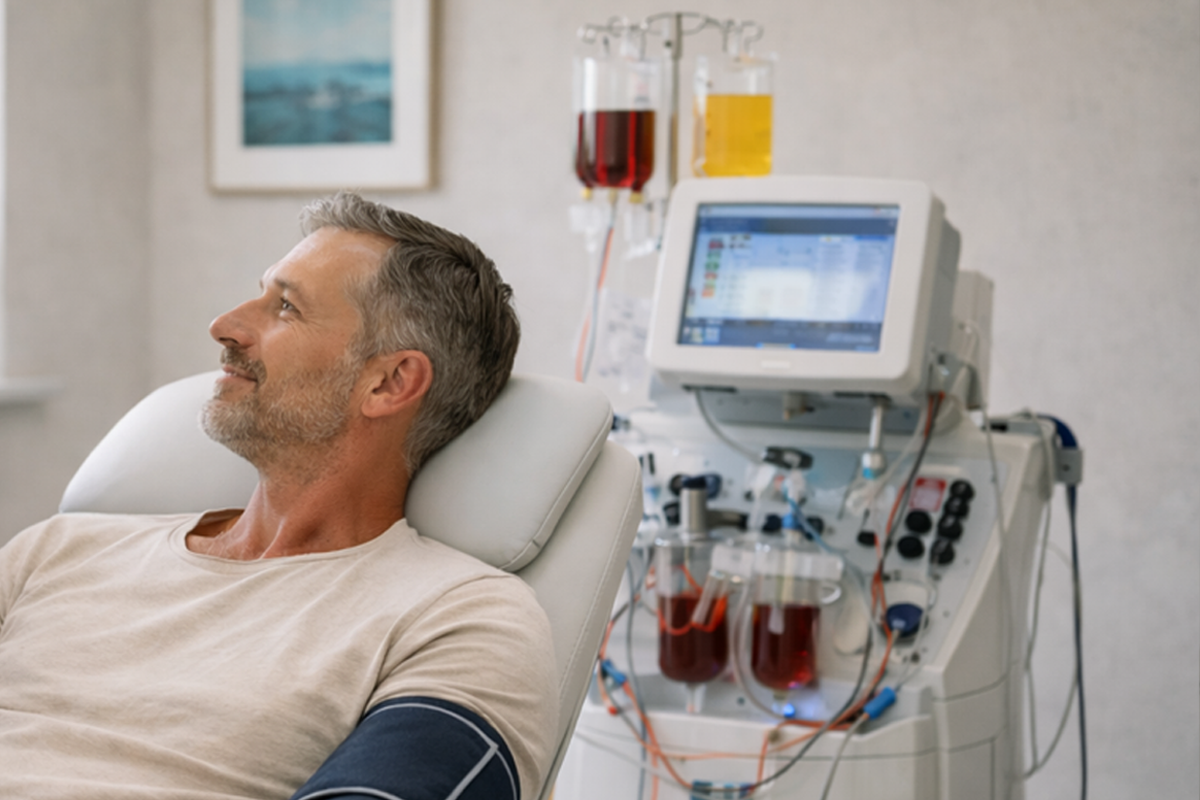
In IUNEpherese™, blood is separated into its cellular components and plasma outside the body. The plasma is then purified extracorporeally and returned to the body. In our view, this is a modern form of blood plasma purification aimed at selective blood purification without broadly replacing the blood’s physiological functions.
IUNEpherese™ is designed to specifically reduce certain substances in plasma. These include, among others, inflammatory mediators, autoantibodies, and immune complexes; altered or dysfunctional proteins; metabolic byproducts; as well as environmental toxins, heavy metals, and microplastics.
“High-quality blood purification doesn’t begin with the procedure itself, but with the environment in which it takes place. At Cell4Care®, we ensure a meticulously prepared treatment environment, clear hygiene standards, and procedures that combine medical precision with a sense of calm.”
"Especially with procedures like IUNEpherese™, it is not just the technology and medical supervision that matter, but also the quality of the preparation, the controlled environment, and the sense of trust that a professional setting creates."
Why it's not just the machine that matters in dialysis
When discussing blood purification, one should not focus solely on the system used. Equally important are the filtration system, the stability of the circuit, the temperature control of the plasma, and the overall medical management of the procedure.
In our view, this is precisely where the differences arise that can be relevant in practice for compatibility, filtration stability, and the quality of medical blood purification. The name of a therapy alone does not explain this. What matters is how the blood purification is actually carried out.
The Role of the Filtration System in Modern Hemodialysis
The filtration system is a central component of every apheresis procedure and, therefore, of every targeted blood purification process. For us, it is not only important that the plasma is purified, but also how precisely, stably, and controllably this process takes place. This is precisely why we do not view the filters, plasma flow, and circulation as separate entities, but rather as a coordinated overall process. In our view, a significant part of the quality of blood purification lies in how well these components interact during the procedure.
Why temperature control is so important for our blood purification
A key component of IUNEpherese™ blood purification is the controlled heating of the plasma prior to the filtration process. For us, this is not a minor technical detail, but a crucial part of a precisely controlled procedure. Keeping the plasma within a physiologically optimal temperature range improves its flow properties.
Controlled plasma temperature regulation is important because it can contribute to improved flow characteristics, a more stable extracorporeal circulation, and more uniform filtration.
At the same time, maintaining a constant temperature helps reduce protein aggregation and fat clumping. This is relevant for practical blood purification because more stable filtration and a lower risk of filter clogging can contribute to a smoother and more technically controlled process. Thus, IUNEpherese™ by Cell4Care represents a precisely controlled and medically integrated form of blood purification.
Why the lower amount of NaCl is relevant for blood purification
A key feature of IUNEpherese™ is the reduced fluid load from NaCl. With an infused volume of approximately 300 to 500 milliliters, the additional volume load is deliberately kept low. This is important because blood purification must be considered not only in terms of the filter, but also in terms of the patient’s circulatory status and overall tolerance of the treatment.
“High-quality blood purification is not determined by the machine alone, but by the precision of the entire process. The filter system, plasma flow, temperature control, and circuit stability work together seamlessly in IUNEpherese™.
This results in a technically controlled process designed to ensure medical quality, tolerability, and precise execution. For Cell4Care®, this is precisely what defines a modern form of blood purification.
The reduced need for heparin is a significant advantage
Improved flow properties and a reduced tendency to aggregate can also reduce the need for heparin. This is an important point because using less heparin can improve treatment tolerance and lower the risk of bleeding. This further demonstrates that high-quality blood purification does not depend on a single factor, but rather on the precise interaction of several procedural characteristics.
Why IUNEpherese™ is more than just a single treatment for us
For us, IUNEpherese™ is not a standalone procedure, but rather part of a comprehensive medical approach. Blood purification therefore encompasses not only the procedure itself, but also the physician’s assessment, appropriate diagnostics, individualized treatment planning, and—depending on the patient’s initial condition—additional therapeutic components. This is precisely why we deliberately chose the name IUNEpherese™. The name makes it clear that this form of blood purification at Cell4Care® is embedded within a broader medical framework.
What Makes IUNEpherese™ Blood Purification at Cell4Care® Unique
When we at Cell4Care® refer to IUNEpherese™ blood purification, we mean a medically supervised form of therapeutic apheresis performed at the IUNE Medical Center by Cell4Care in Palma. For us, several factors are key:
• integration into a medically guided comprehensive treatment plan
• the deliberate selection and precise management of the procedure
• the importance of temperature control and filtration stability
• reduced fluid burden due to NaCl
• consideration of circulation, tolerability, and anticoagulation
• the combination of blood purification with diagnostics and other therapeutic components